Swap refrigerants
The refrigerant is a constructor argument on every released cycle-resolved model family in TMHP. Changing it requires no recalibration and no manufacturer data — pick any name CoolProp recognises and the library re-solves the cycle from first principles. That’s the single most concrete way to see what “refrigerant-agnostic” means in this library.
This page is both a copy-runnable tutorial — sweep four refrigerants at one operating point and inspect the COP — and an engineering reference covering the ten working fluids that actually show up in modern heat-pump design.
Note
Property values quoted below are nominal engineering references from ASHRAE Standard 34 and CoolProp’s REFPROP-grade equations of state. Always reconfirm against the EOS at your specific operating point before sizing — these tables are screening tools, not design data.
Sweep
The sweep uses the ASHPB reference class so all refrigerants see the same source and sink boundary. What changes is the refrigerant EOS and the solved cycle state, not a fitted performance curve.
import pandas as pd

from tmhp import AirSourceHeatPumpBoiler

T_tank_w   = 55.0   # °C
T0         = 5.0    # °C
Q_ref_tank = 8_000  # W

refrigerants = ["R32", "R290", "R410A", "R134a"]

rows = []
for ref in refrigerants:
    ashpb = AirSourceHeatPumpBoiler(ref=ref)
    r = ashpb.analyze_steady(
        T_tank_w=T_tank_w,
        T0=T0,
        Q_ref_tank=Q_ref_tank,
    )
    rows.append({
        "ref": ref,
        "cop_ref [-]": r["cop_ref [-]"],
        "cop_sys [-]": r["cop_sys [-]"],
        "E_cmp [kW]": r["E_cmp [W]"] / 1_000,
        "T_evap_sat [°C]": r["T_ref_evap_sat [°C]"],
        "T_cond_sat [°C]": r["T_ref_cond_sat_v [°C]"],
        "failure_reason": r["failure_reason"],
    })

df = pd.DataFrame(rows)
print(df.to_string(index=False))
The output is a four-row DataFrame — same ASHPB reference boundary, same operating point, four refrigerants. Compressor power, saturation temperatures, and COP all move together with the refrigerant’s EOS.
The cycles, side by side
The same sweep, rendered on three P–h panels so the pressure shift is visible at a glance. R290’s saturation envelope sits roughly an order of magnitude lower than R32’s; R134a lands between the two.
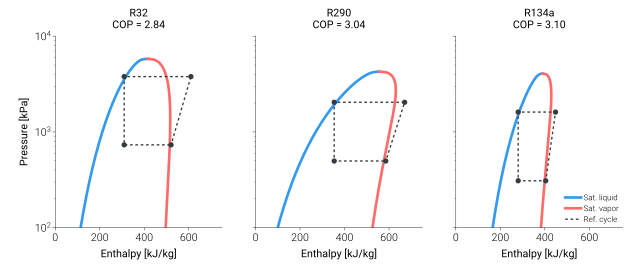
Converged refrigerant cycles for R32, R290, and R134a through
the ASHPB reference boundary at
\(T_{\mathrm{tank}}=55\,^{\circ}\mathrm{C}\),
\(T_{0}=7\,^{\circ}\mathrm{C}\),
\(\dot{Q}_{\mathrm{cond}}=8\,\mathrm{kW}\). Generated by
scripts/visualization/refrigerant_compare_ph.py.
Reading the result
A few things to look for:
failure_reason— should benonefor all four at this operating point. If a refrigerant tripscycle_invalidorhx_not_converged, see failure_reason semantics.``cop_ref`` vs ``cop_sys`` —
cop_refis the cycle COP (condenser duty divided by compressor work).cop_sysalso charges auxiliary power (fan, pumps) and is the figure that matches catalogue datasheets.Saturation temperatures — the evaporating temperature was found by the internal minimiser. Refrigerants with steeper saturation curves end up at different
T_evap_sateven when the heat exchangers are identical.
Reference table
Refrigerant |
Type |
ASHRAE |
GWP100 |
Tcrit [°C] |
NBP [°C] |
Glide [K] |
Primary applications |
|---|---|---|---|---|---|---|---|
R32 |
HFC, single |
A2L |
675 |
78 |
−52 |
0 |
Residential AC and DHW heat pumps; the current R410A successor. |
R290 |
HC (propane) |
A3 |
3 |
97 |
−42 |
0 |
Monoblock outdoor heat pumps; commercial and EU-residential. |
R600a |
HC (isobutane) |
A3 |
3 |
135 |
−12 |
0 |
Domestic refrigeration and small (<300 W) heat pumps. |
R454B |
HFC/HFO blend (R32 / R1234yf, 68.9 / 31.1) |
A2L |
466 |
78 |
−51 |
~1.5 |
Newer residential AC/HP; a near drop-in R410A replacement. |
R134a |
HFC, single |
A1 |
1430 |
101 |
−26 |
0 |
Industrial heat pumps, chillers, transport refrigeration. |
R513A |
HFC/HFO blend (R1234yf / R134a, 56 / 44) |
A1 |
631 |
94 |
−29 |
<0.2 |
Industrial chillers; lower-GWP R134a replacement. |
R410A |
HFC blend (R32 / R125, 50 / 50) |
A1 |
2088 |
72 |
−51 |
<0.2 |
Legacy residential AC/HP; being phased down under F-gas regulation. |
R1234ze(E) |
HFO, single |
A2L |
<1 |
109 |
−19 |
0 |
High-temperature heat pumps and centrifugal chillers. |
R744 |
CO2 |
A1 |
1 |
31 |
−78 (subl.) |
n/a |
Transcritical sanitary hot water (60–90 °C), supermarket refrigeration. |
R717 |
NH3 (ammonia) |
B2L |
0 |
132 |
−33 |
0 |
Large industrial heat pumps and process refrigeration. |
The glide column shows the temperature difference between bubble and dew points at constant pressure inside the two-phase region. Single-component fluids and near-azeotropes (R410A, R513A) glide by < 0.5 K; zeotropic blends (R454B) glide by ~1.5 K, which matters for evaporator design and for fractionation behaviour on a leak-and-recharge cycle.
Refrigerant catalogue
Difluoromethane · single-component HFC
A2L low-flam GWP 675 T_crit 78 °C
Default in this library and the refrigerant Samsung used for the validation unit. The de-facto successor to R410A in residential heat pumps.
Strengths: high volumetric capacity (smaller displacement compressor for the same duty), single- component (no glide, no fractionation on a leak), and about one-third the GWP of R410A.
Watch outs: A2L flammability triggers charge-limit rules in residential applications. Discharge temperatures run hotter than R410A — at high condensing temperatures an oil cooler or liquid injection may be needed.
Typical use: residential AC and DHW heat pumps up to ~70 °C LWT; the current standard for new installations in most markets.
Propane · natural hydrocarbon refrigerant
A3 flammable GWP 3 T_crit 97 °C
Highest COP and lowest GWP of the mainstream picks. The long-term EU choice for residential and small-commercial heat pumps.
Strengths: excellent thermodynamic match for the heat-pump envelope, near-zero GWP, low cost, miscible with mineral and POE oils, drop-in compatible with most copper / brass / steel plumbing.
Watch outs: A3 high flammability brings charge limits (~150 g for residential indoor units under IEC 60335-2-40 Amendment 1; higher for outdoor monoblock), which caps DX system size — most R290 heat pumps are sealed monoblock outdoor units with a hydronic loop into the building.
Typical use: monoblock air-to-water heat pumps, small commercial DHW heat pumps, EU residential.
Isobutane · natural hydrocarbon refrigerant
A3 flammable GWP 3 T_crit 135 °C
The dominant refrigerant in domestic refrigeration; rare but viable for very small heat pumps.
Strengths: highest critical temperature of any HC, which gives headroom for high condenser temperatures. Negligible GWP. Very low operating pressures.
Watch outs: low volumetric capacity (about a third of R290), so the same duty needs a substantially larger displacement compressor — economically unattractive above a few hundred watts. A3 flammability charge limits apply.
Typical use: domestic refrigerators and freezers; some very-small (<300 W) heat-pump products.
R32 / R1234yf zeotropic blend (68.9 / 31.1) · HFC/HFO
A2L low-flam GWP 466 T_crit 78 °C
Designed as a low-GWP, drop-in-ish replacement for R410A in residential AC and heat pumps, with materially similar operating pressures.
Strengths: about 78 % lower GWP than R410A while keeping similar capacity and pressure levels; compatible with R410A-class compressors and brazed-plate heat exchangers; lower discharge temperature than pure R32.
Watch outs: A2L flammability constraints. ~1.5 K glide means the evaporator must be designed for a temperature spread, and fractionation on a partial leak shifts the composition — top off only with new refrigerant from liquid phase.
Typical use: new residential and light-commercial AC and heat pumps in markets where R410A is being retired (US, EU).
1,1,1,2-Tetrafluoroethane · single-component HFC
A1 non-flam GWP 1430 T_crit 101 °C
The classical industrial-chiller and medium-temperature refrigerant. High critical temperature makes it well-suited to high-LWT applications.
Strengths: A1 safety, high Tcrit good for hot DHW or process heating up to ~80 °C, mature compressor and oil ecosystem, very well characterised EOS.
Watch outs: GWP 1430 puts it on F-gas phase-down schedules. Lower volumetric capacity than R32 / R410A means physically larger compressors for the same duty.
Typical use: industrial heat pumps and chillers, large centrifugal chillers, transport refrigeration. Newer designs increasingly use R513A or R1234ze(E) instead.
R1234yf / R134a azeotropic blend (56 / 44) · HFC/HFO
A1 non-flam GWP 631 T_crit 94 °C
Direct R134a replacement that preserves the A1 non-flammable rating while halving the GWP.
Strengths: A1 safety retained (no flammability re-engineering); near-azeotropic (glide < 0.2 K), so drop-in into existing R134a chillers is usually feasible with only minor performance differences.
Watch outs: still F-gas-listed (GWP 631), so long-horizon designs may prefer R1234ze(E) or R515B. Slightly lower volumetric capacity than R134a.
Typical use: retrofit and new industrial chillers and heat pumps where the A1 rating is required.
R32 / R125 zeotropic blend (50 / 50) · legacy HFC
A1 non-flam GWP 2088 T_crit 72 °C
The blend a generation of residential and light- commercial heat pumps were designed for. Strong precedent and tooling, but being phased out.
Strengths: A1 non-flammable, high capacity, mature compressor and component ecosystem.
Watch outs: GWP 2088 puts it on aggressive F-gas phase-down quotas — new equipment is increasingly prohibited (EU F-gas 2024 revision bans most R410A single-split AC ≤ 12 kW from 2027, all by 2032). Comparatively low Tcrit (~72 °C) limits high-LWT applications.
Typical use: existing residential AC/HP installed base; legacy service. Not recommended for new system design.
trans-1,3,3,3-Tetrafluoropropene · single-component HFO
A2L low-flam GWP <1 T_crit 109 °C
Modern HFO with very low GWP and a high critical temperature. Increasingly common in high-temperature heat pumps and centrifugal chillers.
Strengths: GWP under 1, high Tcrit supports condenser temperatures up to ~95 °C, A2L only at elevated temperature (above ~30 °C), single component.
Watch outs: relatively low volumetric capacity — needs a physically larger compressor than R134a for the same duty. Higher cost than legacy HFCs. Material compatibility with elastomers should be verified.
Typical use: large centrifugal water chillers, district heating / industrial water-to-water heat pumps producing 80–95 °C LWT.
Carbon dioxide · natural inorganic refrigerant
A1 non-flam GWP 1 T_crit 31 °C — transcritical
Operates as a transcritical cycle in heating applications: the high side is a supercritical gas cooler, not a condenser. Excellent match for very-high-temperature DHW (65–90 °C) thanks to the temperature glide of supercritical CO2 along the gas cooler.
Strengths: zero ODP, GWP 1, regulatory-future-proof, outstanding performance for hot-DHW heat pumps with cold return water (e.g. Japanese EcoCute), supports condensing-side temperatures other refrigerants can’t reach without compromising COP.
Watch outs: very high operating pressures (~100 bar on the gas-cooler side) — requires purpose-built compressors, heat exchangers, and instrumentation. Sub-cooler / expander details dominate COP; can’t be analysed with a subcritical-condenser model — see Refrigerants and CoolProp for how TMHP currently treats this case.
Typical use: sanitary-water heat pumps (Japan, Europe), commercial / supermarket refrigeration, transport refrigeration.
Ammonia (NH:sub:`3`) · natural inorganic refrigerant
B2L toxic, low-flam GWP 0 T_crit 132 °C
The classical industrial refrigerant. Exceptional thermodynamic performance and zero environmental impact from emissions, but operates under strict safety codes.
Strengths: highest cycle efficiency of any common refrigerant for typical industrial duties; zero GWP and zero ODP; very high Tcrit enables high-LWT operation; pungent self-alarming odour aids leak detection.
Watch outs: toxic (Class B), incompatible with copper and brass alloys (steel and aluminium plumbing only), requires trained operators and ammonia-specific safety systems (ventilation, gas detection, evacuation procedures). Capital costs and footprint reflect the safety engineering.
Typical use: large industrial heat pumps, food-process refrigeration, cold storage, district heating with recovered industrial heat.
Picking by application
Use the sweep above as a screening step against the constraints that actually matter for your application. A rough decision guide:
- Residential AC / heat pump (split or monoblock, ≤ 12 kW, LWT ≤ 65 °C)
R454B (new) or R32 (still allowed in most markets) for split systems; R290 for sealed monoblock outdoor units. R410A only for service of existing installs.
- Domestic DHW heat pump (LWT 55–65 °C)
R32 or R290 for subcritical designs; R744 for the very-high-LWT (≥ 65 °C with cold return) hot-water-heat-pump pattern.
- High-temperature industrial heat pump (LWT 80–95 °C)
R1234ze(E), R134a, or R717 (ammonia). R600a is occasionally used for niche small units. TMHP solves these subcritically as long as Tcrit clears the condenser by ~10 K; check
failure_reasonforcycle_invalid.- Very-high-LWT (≥ 90 °C) industrial heat pump
R717 (ammonia) or R718 (water) — the latter requires a radically different compressor class and is not modelled here. Pure R134a / R1234ze(E) can reach 90 °C but with diminishing COP.
- Transcritical sanitary hot water (≥ 65 °C, cold return)
R744 — the only mainstream refrigerant whose cycle is optimised for this duty. Not subcritical, so the TMHP result is a sanity check rather than a design; see Refrigerants and CoolProp.
- Industrial refrigeration and process cooling
R717 (ammonia) is the workhorse. R744 (CO2) is the growing alternative, often in CO2/NH3 cascade systems for supermarkets and cold storage.
The screening table above narrows the candidate list. Once one or two refrigerants survive, re-run a full annual simulation with realistic schedules — see Realistic dynamic simulation.
Screening criteria summary
To recap the levers when picking from the table:
Operating-point COP — what the sweep above reports. The refrigerant with the best COP at one operating point is rarely the best across an annual envelope; always confirm against
analyze_dynamicwith a realistic schedule.Flammability class — A1 (R410A, R134a, R513A, R744) → A2L (R32, R454B, R1234ze(E)) → A3 (R290, R600a). B-class (R717) is toxic and brings its own code regime.
GWP — for new systems aim for GWP < 700 to align with the EU F-gas 2024 phase-down. R744 / R717 / R290 / R600a / R1234ze(E) are GWP-future-proof.
Critical temperature — sets the practical condenser ceiling for a subcritical cycle. Check the
T_ref_cond_sat_vcolumn from the sweep against the refrigerant’s Tcrit in the table.Glide — > 1 K (R454B) means the evaporator should be counter-flow and the refrigerant must be charged from the liquid phase.
Refer to Refrigerants and CoolProp for how CoolProp handles each refrigerant and the cycle-architecture implications.